The Weight of "Should": How Shame Becomes the Invisible Load We Carry
Feb 6, 2026
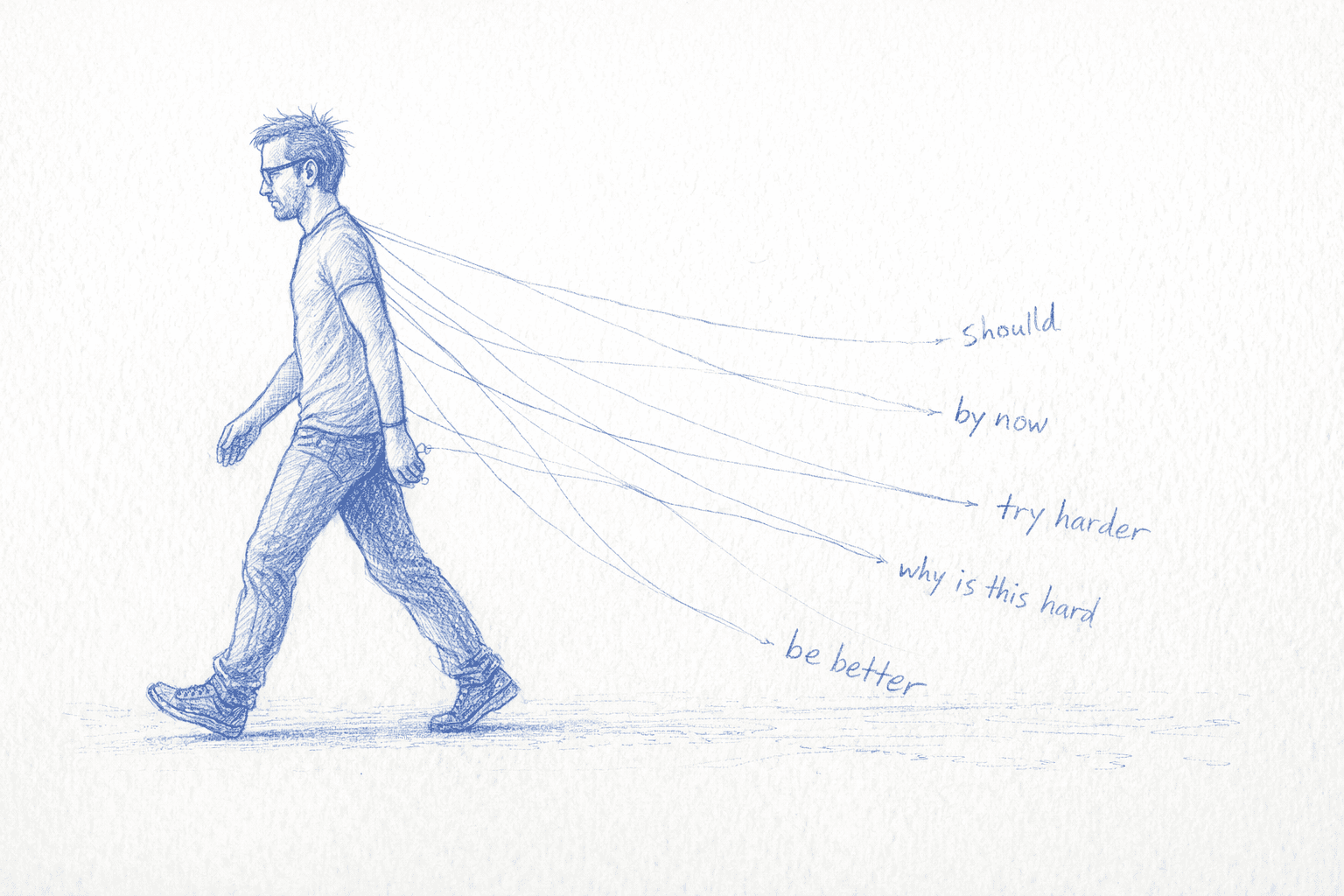
There's this exhaustion that doesn't come from working too hard. It comes from always feeling like you're already behind.
Not behind other people exactly. Behind some invisible checklist it seems like everyone else got at birth.
You know the one:
You should be more organized.
You should follow through.
You should answer emails faster.
You should stop starting shit and actually finish something.
You should be able to do this by now.
For a lot of us with ADHD, life isn't just moving forward. It's moving forward while this constant background commentary keeps score of every time you veer off the "right" path. Over years, that commentary stops being annoying. It gets heavy. It turns into shame.
Not the loud, crying-in-the-shower kind. The quiet, always-there kind. The kind that's humming while you're washing dishes, doom-scrolling at 2 a.m., or staring at a project you actually give a damn about but can't make yourself touch.
This isn't about motivation. It's not about discipline. It's not about trying harder.
It's about what happens when an ADHD brain keeps smashing into a world built for linear, predictable performance. And what it does to you emotionally after decades of that collision.
How the "Should" Gets Installed
Most of us didn't decide to hate ourselves one morning. That inner critic got trained.
Early on the feedback loops in:
"You're so smart, but..."
"You've got so much potential, if only..."
"Why can't you just..."
"Everyone else can handle this."
It's rarely mean on purpose. But it stacks up.
ADHD is executive function going offline at the worst times — planning, starting, switching, finishing, regulating emotion. The brain hardware for "doing life on command" is glitchy.
But the world doesn't see executive function. It sees results.
Missed deadlines = irresponsible.
Messy = careless.
Inconsistent = character flaw.
Eventually the judgment doesn't need to come from outside anymore. We start saying it ourselves.
By adulthood a lot of us aren't just dealing with symptoms. We're running a private court case against ourselves, collecting evidence that we're failing at basic adulting.
Executive Dysfunction + Moral Judgment = Shame
Here's the ugly equation nobody writes down but we all learn:
If it's easy for them and hard for me, then the problem is me.
Focus gets called "effort."
Getting organized gets called "discipline."
Following through gets called "integrity."
So when the system crashes, it doesn't feel like wiring. It feels like laziness. Selfishness. Not caring enough. Even — especially — when you care more than anyone knows.
That's why the shame cuts so deep. It's not "I fucked up." It's "I fucked up again, and this just proves what I've suspected all along."
Society, work, school — they all keep reinforcing it until the tape plays on autopilot.
Then Add Rejection Sensitive Dysphoria and It Gets Ugly Fast
RSD turns any hint of criticism into a full nervous-system alarm. A sigh. A late reply. A flat comment. Boom — panic, rage, shutdown, disappearance.
When you're always scanning for proof you've let someone down, shame stops being reactive. It becomes pre-emptive. You're not waiting for the mistake. You're trying to head off the rejection.
So you get:
Over-explaining.
People-pleasing.
Hiding.
Or torching the bridge before they can push you off.
None of it feels strong. It feels like survival.
What Shame Looks Like in Real Life
Most days it's not dramatic. It's quiet and functional.
The inner narrator that mutters:
"Why bother?"
"You'll fuck it up anyway."
"You always do this."
"If you were actually good at this, it wouldn't be hard."
It feels true because it's so familiar.
Masking hard in public — being the funny one, the helpful one, the one who's "fine" — then crashing alone because pretending takes more energy than you've got.
Avoidance that looks like procrastination but really it's terror: starting the thing might prove the awful story you already believe about yourself. So the task turns radioactive.
Perfectionism as armor: If I do it perfectly, no one can judge me. If I do it perfectly, I can finally breathe. (Spoiler: you never breathe.)
The Problem With "Just Be Nicer to Yourself"
People throw self-compassion at us like it's simple. Like a slogan fixes it.
But for us shame isn't a bad attitude. It's a reflex baked in deep.
Undoing it doesn't start with mirror affirmations. It starts with ripping up the operating system.
First: Separate what you do from who you are.
Your brain learned mistake = danger. Unlearning that takes repetition and proof.
A missed deadline is information.
A chaotic desk is information.
An unfinished thing is information.
None of it is a verdict on your worth.
Change the question from "What's wrong with me?" to "What support, structure, or setup was missing here?"
That one switch changes the whole game.
Second: Ditch "should" for "what actually works for me."
"Should" is borrowed bullshit. Someone else's schedule, someone else's dopamine wiring, someone else's idea of normal.
ADHD brains don't need tighter rules. They need rules that actually fit.
Instead of "I should be able to focus for hours," try: "What conditions let me lock in?"
That's where the real shift happens. Not in forcing yourself to match the neurotypical script. In building one that doesn't slowly kill you.
Contact
Follow
Newsletter
RSS
Shop
Legal & More
Affiliate Disclosure
Privacy
Accessibility