When Brainstorms Get Loud: How Conversation-Driven Creatives Actually Get Sh*t Done
Jan 29, 2026
The Myth of the Quiet Creative
Some of the best ideas I have ever seen did not happen in a boardroom with a whiteboard and a carefully curated 27-slide deck. They did not come from a scheduled "innovation session" where everyone sits in ergonomic chairs and waits for their turn to speak. Most of the real breakthroughs happened halfway through a rant in the kitchen while someone was reheating their lunch. They happened five minutes into a random hallway tangent that somehow derailed into a brand new product idea. This kind of talk first and figure it out later creativity might look chaotic from the outside, but inside a team that knows how to ride the wave, it is pure gold.
I have run creative studios, tech startups, and digital teams for a couple of decades now. One thing that consistently drives innovation is loud, kinetic, and sometimes gloriously unstructured conversation. This is a dive into how that works, why it works, and what you can do to make it work better without killing the magic. We are talking about the difference between a sterile brainstorm and a living, breathing idea factory.
The Magic of the Hallway-Kitchen Brainstorm
Spontaneous Combustion in a Good Way
The classic brainstorming meeting with agendas and sticky notes is fine, I guess. It serves a purpose for people who need a paper trail. But the truth is that forcing creativity into a specific time block usually feels like trying to catch lightning in a very small, very corporate bottle. The real sparks happen in those unscheduled collisions. It happens by the coffee machine, walking back from the bathroom, or mid-rant about the printer jamming for the fourth time today.
That kinetic swirl of noise and movement is important. It is slightly ADHD in nature, and that is a good thing. It lights up parts of the brain that a sterile meeting room just does not touch. I once wrote about this as Noise, Movement, and Momentum. The core idea is simple: motion equals emotion equals momentum. When your body is moving and your voice is active, your brain stops overthinking and starts connecting.
Happy Accidents and Unexpected Brilliance
There is this amazing thing that happens when you are talking about one problem and accidentally solve another. Someone is riffing about how the onboarding process sucks. Someone else blurts out a feature tweak for an entirely unrelated product. Suddenly, you have a new roadmap item that solves three problems at once. That is the beauty of these messy overlaps. Serendipity lives in the noise. If you keep everyone in their silos, you never get those accidental collisions of brilliance.
Real-Time Idea Stress Testing
The great thing about a dynamic conversation is that you get feedback instantly. If someone says “What if we do this?” and three people wince at the same time, you know it is time to pivot. You do not need a formal pitch review or a committee vote. You just need a few well placed raised eyebrows and a collective groan. This kind of quick iteration is how ideas get shaped fast. Rough edges get sanded down in real time because the conversation moves too quickly for ego to get in the way. That is how stuff actually moves from a thought to a reality.
The Social Glue: Why This Works
Trust Is Everything
For this not to go off the rails, you need a culture where people feel safe tossing out half-baked thoughts. You cannot have people afraid of being roasted for a "dumb" idea. You want the kind of environment where someone can say something totally weird and instead of hearing crickets, someone else says: “Okay, but what if we did that, but upside down?”
That kind of psychological safety does not just appear because you put it in the employee handbook. You build it over time through shared wins, good leadership, and maybe a few group therapy sessions after trying to launch too many things at once. It comes from knowing that the goal is the best idea, not the loudest ego.
Neurodiverse Brains are Superpowers
Here is something I have seen over and over: teams that click like this often have a mix of brains. You have people with ADHD throwing out wild and unexpected connections. You have folks on the spectrum bringing that laser focus that anchors the chaos. Neurodivergence is not just a footnote. It is the engine of a lot of this kinetic creativity. I wear the label of "ADHD creative guy" like a badge of honor. It is not a bug. It is a feature. You just have to build the system around it so it does not short circuit the entire office.
Someone Needs to Steer the Ship
Even in a kitchen brainstorm, someone has to quietly make sure the rocket does not fly sideways into a wall. That is where facilitators come in. They are not like a teacher with a pointer. They are more like a good bartender. They keep things flowing. They make sure no one is hogging the mic. They jot down the good stuff before it evaporates into the air. A good leader in this environment knows when to step in and when to get out of the way of a good tangent.
Common Pitfalls and How to Dodge Them
Loudest Voice Syndrome
Without some guardrails, these brainstorms can devolve into the Alpha Voice Show. This is where only the loudest or most senior folks get airtime. That kills innovation faster than anything else. The best ideas often come from the quietest corners of the room. You have to make room for everyone. Use tricks like a quick round robin or just pause the room and ask a specific person for their take. It matters that everyone feels they have a seat at the table.
The Star Trek Tangent
The same kinetic energy that fuels these moments also makes it very easy to veer off into a debate about which Star Trek captain would make the best product manager. For the record, the answer is Picard. To keep things semi-useful, you need light structure. You need a facilitator. You need ground rules. Maybe you even need a time limit. Let the conversation breathe, but give it borders so you actually end up with a result.
The Tragedy of Ghost Ideas
This one kills me every time. You are in the middle of a heated and brilliant 20 minute breakthrough conversation, and no one wrote a single thing down. The moment the conversation ends, the idea is gone. It is lost in the ether. Seriously: appoint a scribe, fire up a shared document, or even record the conversation if that is okay with the group. It does not have to be pretty. You just need to capture the essence before it floats away.
How to Make It Work Without Killing the Vibe
Build Spaces for Serendipity
Design your space, whether physical or virtual, so these brainstorms can actually happen. Use big open tables. Cover the walls in writable surfaces. Keep snacks within reach. Comfort equals creativity. In remote teams, this means having Slack huddles or Discord channels where people can just talk without scheduling a whole meeting just to say “what if?”
Mix the Crowd Frequently
Cross functional collisions are where the magic happens. You want designers talking to developers. You want the operations team chatting with marketing. Throwing people from different zones into the same sandbox tends to lead to very cool outcomes that no one could have predicted in a vacuum.
Async Can Be Loud Too
Not everything has to be live. Some of my best brainstorms have started in long and unhinged Slack threads at 11 p.m. Let people chime in when the ideas hit, whether that is at lunch or at midnight. Tools like Notion, Miro, and Discord are great for this. The goal is to keep the conversation going, regardless of the medium.
Track the Chaos Constantly
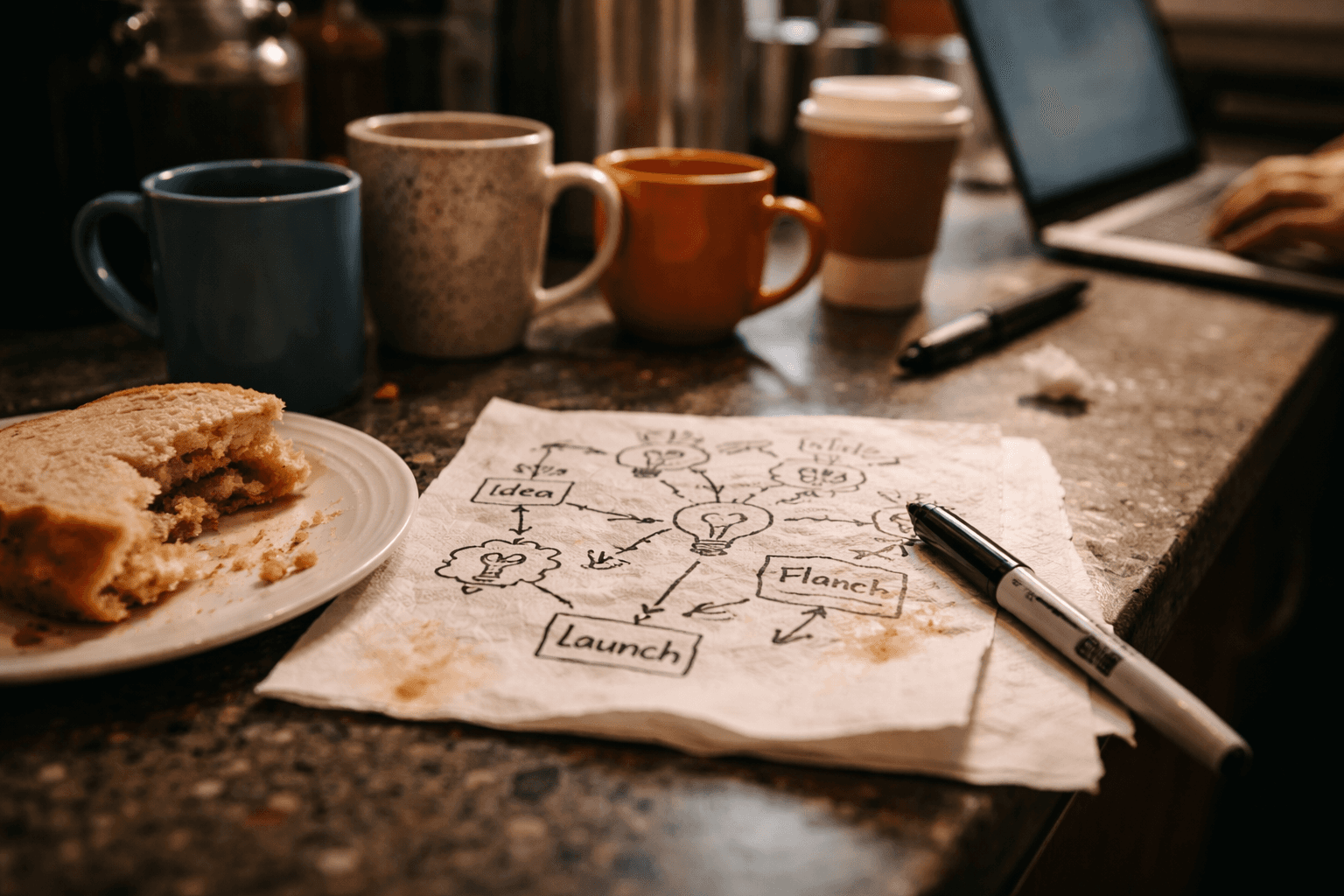
Use idea boards or sticky tools. Have a shared Notion database. Use something. Anything. I have built entire product roadmaps off the back of kitchen whiteboard photos and napkin sketches that someone had the good sense to upload before they disappeared. If you do not track the chaos, you are just making noise.
Let It Breathe, Then Land the Plane
Chaos is fun and powerful. But it needs to be followed by a solid stretch of focus and execution. I like to call these reset windows. These are quiet zones where ideas settle, plans get real, and we actually ship something. Otherwise, you are just spinning in a brainstorm tornado forever. You have to know when to stop talking and start doing.
Loud, Even When Remote: Tools That Keep the Noise Moving
Hallway conversations do not happen naturally when everyone is sitting in different time zones and buried in calendar invites. But remote does not have to mean quiet. You can absolutely build that same kinetic energy across screens, as long as you create space for it.
Slack Huddles and Always-On Audio Channels
Set up drop-in voice lounges or time-boxed huddles where people can just talk without an agenda. No slide decks. No hand-raising. Just real-time “what if” energy.FigJam and Miro Boards
Think of these as your digital whiteboards, open all day. Anyone can jump in, add a thought, draw a terrible sketch, or drop in a comment. The important part is that ideas are allowed to live in motion, not locked in a slide somewhere.GetRethink.com
This one takes creative collaboration into the immersive zone. Built for XR and Meta Quest headsets, it gives remote teams the feeling of being back in the same room together. You get presence, body language, shared energy, none of the Zoom fatigue. It also cuts context switching and distraction down to almost zero. You drop into the space, focus hard, and jam like you're whiteboarding across the table again.
The key with all of this is not the platform. It is the permission. You need to let people speak up, riff, and collaborate without waiting for the next scheduled meeting. Give them room to be noisy, and the ideas will come.
Final Thought: Loud Is Not Lazy
The informal and messy brainstorm is not a lack of discipline. It is a different kind of discipline altogether. It is the art of channeling conversation into creation. It is about recognizing that a weird aside might just be the next million dollar idea. It is about trusting your team to know when to go wild and when to get serious. I have seen it work across agencies, game teams, startups, and creative collectives. It is not for everyone, but for the right crew, it is magic.
Call to Action
So here is the ask for you today: build your team to talk. Create space for those hallway moments. Capture the chaos when it happens. Mix your brain types and value the neurodivergent perspectives. And most importantly: do not be afraid when the brainstorms get loud. That noise you hear is the sound of ideas being born.
If you want to dive deeper into how to set up these kinetic systems or how to manage a team of high energy creatives, let’s talk. We can look at your current workflow and see where we can inject a little more productive chaos.
Contact
Follow
Newsletter
RSS
Shop
Legal & More
Affiliate Disclosure
Privacy
Accessibility